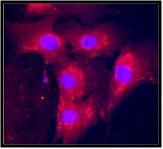
Vascular endothelial growth factor (VEGF) is a dimeric glycoprotein that stimulates vasculogenesis and angiogenesis. VEGF belongs to a family of closely related growth factors that share a conserved pattern of eight cysteine residues and bind to common VEGF receptors. The VEGF family members bind in an overlapping manner to three receptor tyrosine kinases, VEGFR1, VEGFR2 and VEGFR3. Specifically, VEGF mediates angiogenic response by the activation of VEGFR2. VEGF is produced at high levels in endothelial cells but its expression can be found in other cell types, including fibroblasts, inflammatory cells, and many tumor cells, often in response to increasing tumor hypoxia via the HIF-1a pathway. Overexpression of VEGF can contribute to diseases such as cancer and vascular disease in the retina; also, VEGF is a cause of susceptibility to microvascular complications of diabetes type 1 such as diabetic retinopathy, diabetic nephropathy and diabetic neuropathy.